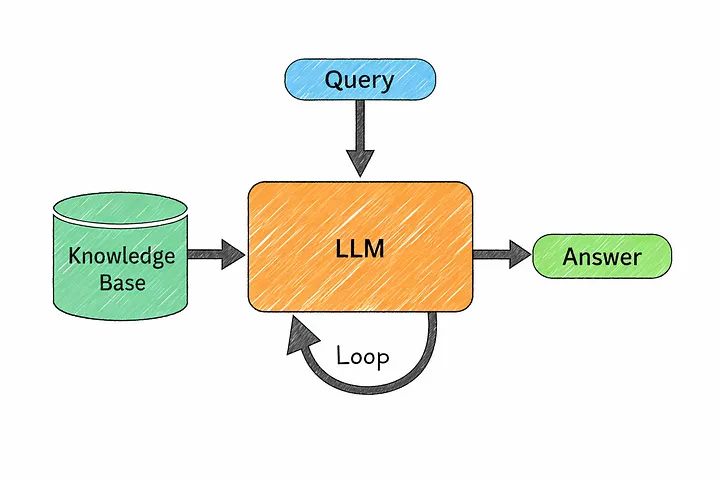
The future of AI isn’t just about building better individual models — it’s about building better systems around those models. A raw language model, no matter how capable, is limited by what it learned during training and by what it can do in a single forward pass. Real-world AI products solve this by combining models with retrieval, memory, tools, and feedback loops.
This post walks through four of the most important system-level patterns in production AI today: Retrieval-Augmented Generation, vector databases, AI agents, and diffusion models.
Retrieval-Augmented Generation (RAG)
One of the most effective ways to improve an AI system’s accuracy is to stop relying solely on what the model memorized during training, and instead connect it to external, up-to-date information sources.
This is the idea behind Retrieval-Augmented Generation. Instead of generating an answer purely from its internal knowledge, the model first retrieves relevant documents or passages from an external knowledge base, then uses that retrieved context to generate a more accurate, grounded answer.
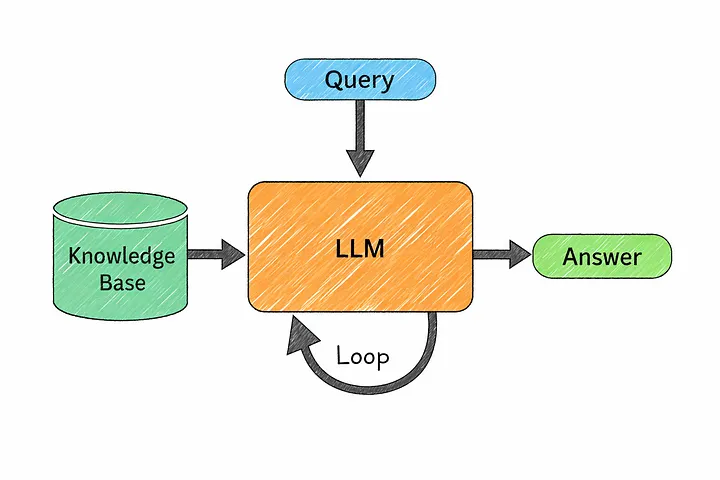
This pattern is especially valuable for use cases involving private company data, frequently changing information, or any domain where factual precision matters more than fluency — since it directly addresses the hallucination problem by grounding responses in real, retrievable source material.
Vector Databases
RAG systems need a fast, reliable way to find the most relevant pieces of information for a given query — and that’s exactly what vector databases are built for.
A vector database stores embeddings: the numerical representations of text (or images, audio, and other data) that capture semantic meaning. When a query comes in, it’s also converted into an embedding, and the database returns the stored items whose embeddings are mathematically closest to the query — meaning, semantically, they’re the most relevant matches.
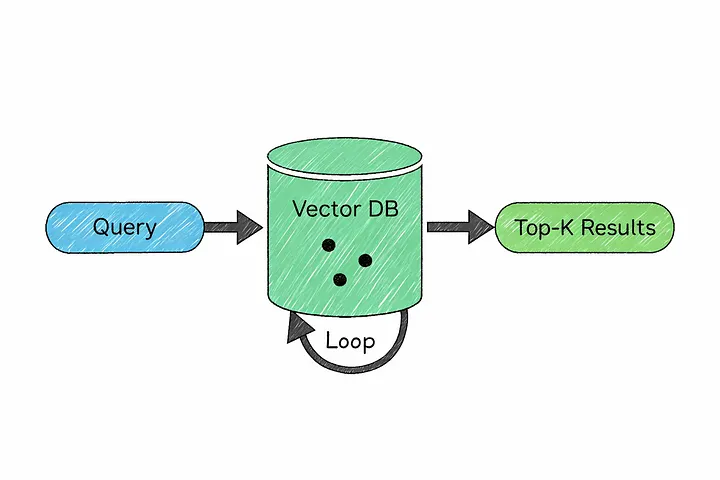
Some of the most widely used vector database options include:
- Pinecone — a fully managed, production-ready vector database
- Qdrant — open-source with strong performance characteristics
- Weaviate — combines vector search with structured filtering
- Chroma — lightweight and popular for prototyping and smaller projects
This kind of semantic search is what makes RAG systems practical at scale — searching not by exact keyword matches, but by actual meaning.
AI Agents
While a standard LLM responds to a single prompt and stops, an AI agent is designed to go further: it can reason about a goal, decide on a sequence of actions, and actually execute those actions using external tools.
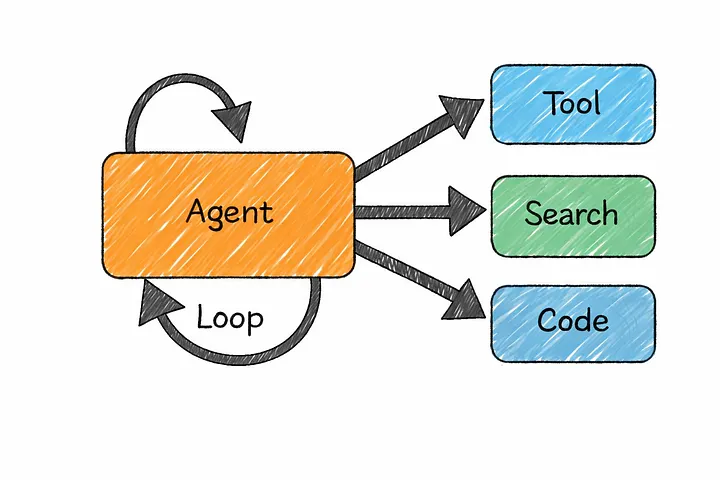
A typical agent can:
- Search the web or internal documents for information it doesn’t already have
- Reason through multi-step problems, deciding what to do next based on intermediate results
- Plan a sequence of actions needed to accomplish a larger goal
- Execute tasks directly — running code, calling APIs, or interacting with other software
This loop of reasoning and acting is what allows agents to handle genuinely complex, multi-step workflows that a single prompt-response exchange simply can’t — things like researching a topic across multiple sources, debugging code iteratively, or completing a task that requires several dependent steps in sequence.
Diffusion Models
Not every modern AI breakthrough is about text. Diffusion models are the technology behind most of today’s leading image and video generation systems.
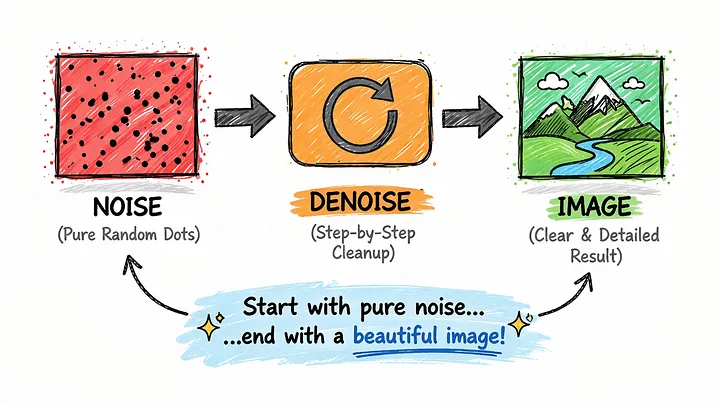
Rather than generating an image directly in one step, diffusion models work by learning to reverse a noising process — starting from pure random noise and gradually removing that noise, step by step, until a coherent, detailed image emerges.
This technique has become foundational across several creative and technical domains:
- AI art and image generation
- Video generation and editing
- 3D asset and design generation
- Scientific applications, including molecular and material modeling
Looking Ahead
The most capable AI applications being built today rarely rely on a single model in isolation. Instead, they combine several of these patterns together:
- LLMs provide the core reasoning and language capability
- RAG grounds responses in accurate, current information
- Vector databases make that retrieval fast and semantically meaningful
- Agents extend a model’s ability to act, not just respond
- Diffusion models bring generative capability to images, video, and beyond
Together, these technologies are shaping what the next generation of intelligent software actually looks like — systems that don’t just generate plausible text, but that can retrieve real information, take real actions, and produce real creative output, all working in concert.